Learning Forex can feel a bit like learning a new language.
One minute you’re looking at a chart, and the next you’re hearing words like “pip,” “lot size,” “spread,” and “leverage.”
It’s enough to make many beginners close the trading platform and walk away.
The good news?
You don’t need to learn hundreds of trading terms to get started.
In fact, if you understand the 25 terms below, you’ll already know more than most new traders.
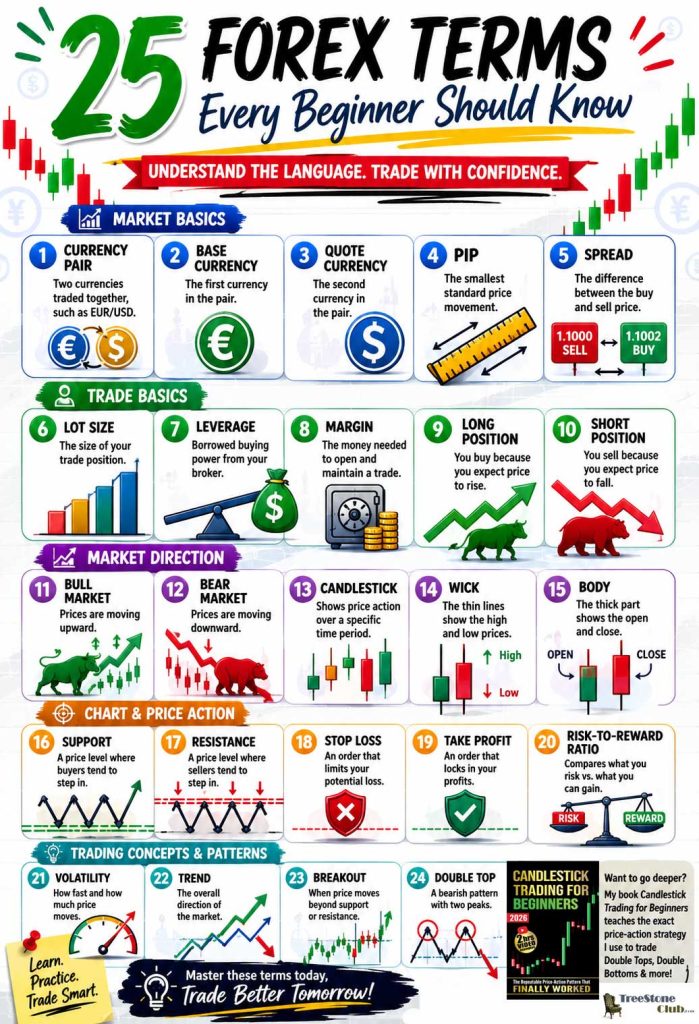
1. Currency Pair
Forex trading always involves two currencies.
For example:
EUR/USD
GBP/USD
USD/JPY
The first currency is compared against the second.
2. Base Currency
The first currency in a pair.
In EUR/USD, the Euro (EUR) is the base currency.
3. Quote Currency
The second currency in a pair.
In EUR/USD, the US Dollar (USD) is the quote currency.
4. Pip
A pip is the smallest standard movement in most Forex pairs.
Think of it as the Forex market’s measuring tape.
Traders often talk about making or losing pips rather than dollars.
5. Spread
The difference between the buying price and selling price.
Every trade starts slightly negative because of the spread.
6. Lot Size
The size of your trade.
Larger lot sizes mean larger profits and larger losses.
7. Leverage
Leverage allows you to control a larger position with a smaller amount of money.
It can increase profits, but it can also increase losses.
8. Margin
The amount of money required to open a leveraged trade.
Think of it as a security deposit held by your broker.
9. Long Position
A trade placed because you expect price to rise.
Simply put: you’re buying.
10. Short Position
A trade placed because you expect price to fall.
Simply put: you’re selling.
11. Bull Market
A market moving upward.
Bulls push prices higher.
12. Bear Market
A market moving downward.
Bears push prices lower.
13. Candlestick
A candlestick shows price movement during a specific period of time.
Candlesticks are the foundation of many trading strategies.
14. Wick
The thin line extending above or below a candlestick.
It shows how far price moved before reversing.
15. Body
The thick part of the candlestick.
It shows where price opened and closed.
16. Support
A price area where buyers tend to step in.
Support often acts like a floor beneath price.
17. Resistance
A price area where sellers tend to step in.
Resistance often acts like a ceiling above price.
18. Stop Loss
An order that automatically closes a trade to limit losses.
Every trader should understand stop losses before risking real money.
19. Take Profit
An order that automatically locks in profits when a target is reached.
20. Risk-to-Reward Ratio
The amount you’re risking compared to the amount you’re hoping to make.
Many successful traders focus heavily on this number.
21. Volatility
A measure of how quickly prices move.
High volatility means bigger price swings.
22. Trend
The overall direction of the market.
Markets can trend upward, downward, or move sideways.
23. Breakout
When price moves beyond an important support or resistance level.
Breakouts often lead to larger market moves.
24. Double Top
A bearish chart pattern featuring two peaks.
Many traders view it as a potential signal that an uptrend is ending.
25. Double Bottom
A bullish chart pattern featuring two troughs.
Many traders view it as a potential signal that a downtrend is ending.
Why These Terms Matter
Most beginners spend too much time searching for a “secret strategy.”
The truth is that understanding basic Forex terminology gives you a much stronger foundation than chasing indicators and shortcuts.
Once you understand how candlesticks, trends, support, resistance, risk management, and chart patterns work together, trading starts to make much more sense.
Want to Learn How I Actually Trade?
Knowing the terminology is one thing.
Applying it to real charts is another.
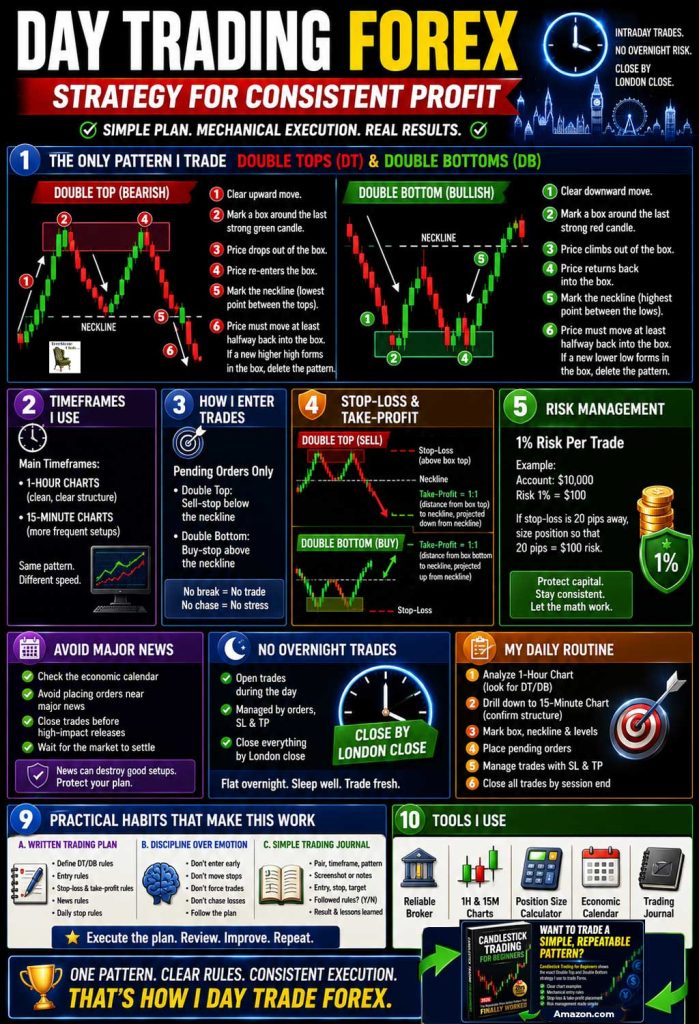
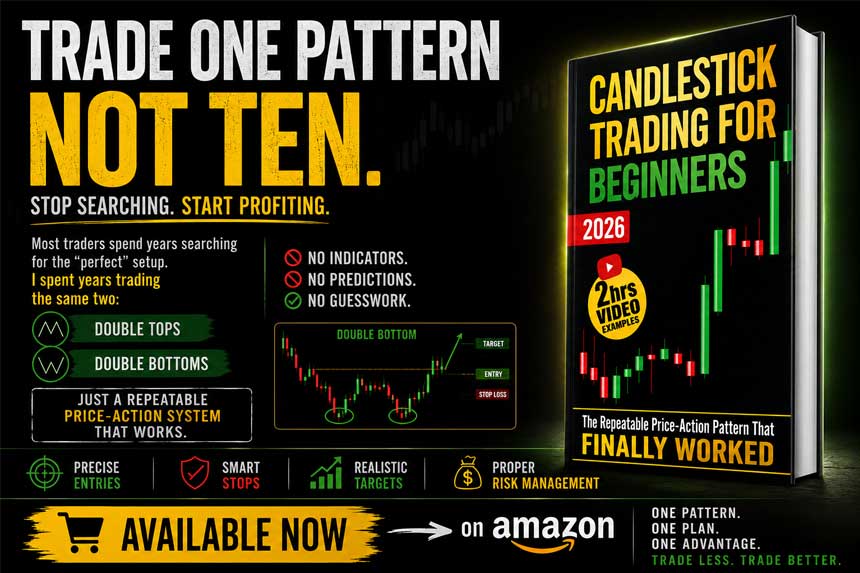
In my book, Candlestick Trading for Beginners, I walk through the exact candlestick-based approach I use, including how I identify Double Tops and Double Bottoms, where I place entries, how I manage risk, and the mechanical process that finally helped me simplify trading.
It’s written specifically for beginners who want a straightforward, price-action approach without complicated indicators or endless screen time.
It’s a natural next step.
Check it out on Amazon.com
Check it out on Amazon.com