Nobody starts trading Forex knowing what they’re doing.
We all make mistakes.
The problem isn’t making them.
The problem is making the same expensive mistakes over and over again.
Most blown accounts aren’t caused by one bad trade. They’re caused by a collection of small mistakes that slowly drain confidence, discipline, and capital.
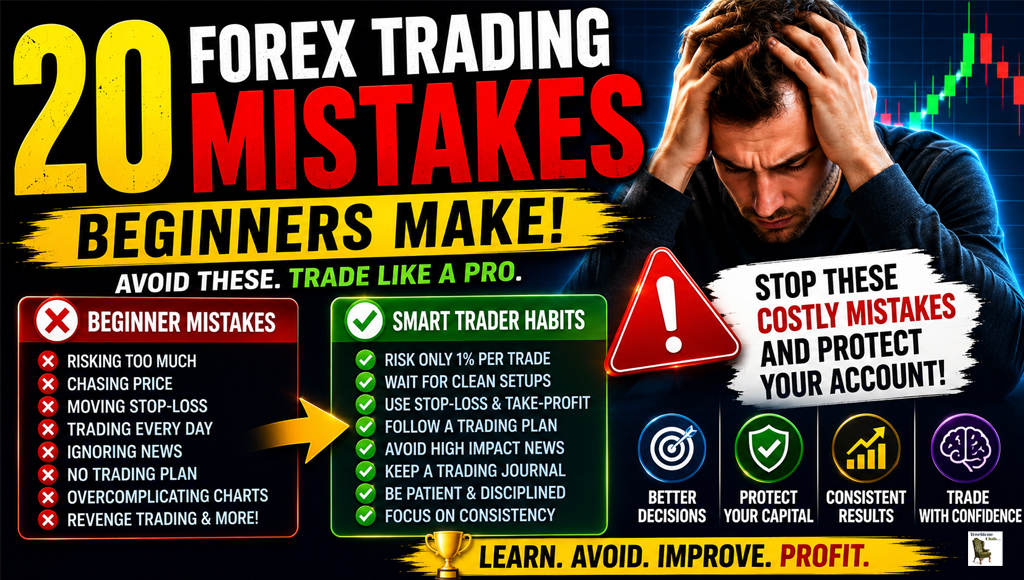
Here are 20 Forex trading mistakes I see beginners make all the time—and more importantly, how to avoid them.
1. Trading Without a Plan
Many beginners open trades based on a feeling.
That’s not a strategy.
Before placing a trade, you should know:
- Why you’re entering
- Where your stop-loss goes
- Where your target goes
- How much you’re risking
No plan = no consistency.
2. Risking Too Much on One Trade
One trade should never be able to seriously damage your account.
I risk a maximum of 1% per trade.
That allows the strategy to play out over dozens of trades without emotional panic.
3. Chasing Price
Price takes off.
You feel you’ve missed the move.
You jump in late.
Then price reverses.
Beginners chase.
Professionals wait.
4. Trading Every Day
Some days there are no good setups.
That’s normal.
Trading because you’re bored is one of the fastest ways to lose money.
5. Moving a Stop-Loss
The trade gets close to your stop.
You move it.
Then move it again.
Then again.
Before long, a small loss becomes a large one.
A stop-loss only works if you respect it.
6. Ignoring Economic News
A beautiful setup can be destroyed by a major news release.
Always check the economic calendar before placing trades.
7. Trading Too Many Currency Pairs
Beginners often watch ten or fifteen pairs.
That’s overwhelming.
Start with a handful of major pairs and learn their behaviour.
8. Overcomplicating Charts
Indicators.
More indicators.
Even more indicators.
Soon you can’t see the price itself.
Simple charts are often the most effective charts.
9. Revenge Trading
A loss occurs.
You immediately try to win it back.
This rarely ends well.
The market doesn’t know you lost money.
10. Taking Trades Without a Clear Edge
If you can’t explain exactly why you’re entering a trade, you probably shouldn’t be taking it.
11. Risking Different Amounts Every Trade
One trade risks 1%.
The next risks 5%.
The next risks 2%.
Inconsistent risk creates inconsistent results.
12. Trading Lower Time Frames Too Soon
The 1-minute chart looks exciting.
It also contains a lot of noise.
Many beginners would do better starting on the 1-hour chart.
13. Ignoring Risk-to-Reward
A trade risking 50 pips to make 10 rarely makes sense.
Every trade should have a favourable risk-to-reward relationship.
14. Taking Every Setup You See
Not every pattern deserves a trade.
Patience is part of the strategy.
15. Trading While Emotional
Angry.
Frustrated.
Excited.
Desperate.
None of these are good trading conditions.
16. Not Keeping a Journal
Most traders remember their winners.
They forget their mistakes.
A trading journal tells the truth.
17. Holding Losing Trades and Closing Winners Early
This is one of the most common beginner habits.
Cut winners short.
Let losers run.
Exactly backwards.
18. Looking for the “Perfect” Strategy
The perfect strategy doesn’t exist.
Consistency comes from execution, not perfection.
19. Ignoring Position Sizing
A good setup with poor position sizing can still damage an account.
Position size matters.
A lot.
20. Breaking Your Own Rules
This is the biggest mistake of all.
Most traders already know what they should do.
The challenge is actually doing it.
Discipline beats intelligence in trading more often than people realise.
The Biggest Lesson
After years of studying charts, one thing became obvious:
Most traders don’t lose because they lack knowledge.
They lose because they repeatedly break simple rules.
The market doesn’t reward excitement.
It rewards consistency.
The Simple Rules I Follow
My own approach is built around:
✔ Double Tops and Double Bottoms
✔ Pending orders
✔ Fixed stop-losses
✔ Fixed take-profits
✔ 1% risk per trade
✔ No trading into major news
✔ No overnight positions
Simple.
Repeatable.
Mechanical.
Want the Full Trading Process?
Many of the mistakes above disappeared when I stopped jumping between strategies and started following one repeatable method.
In Candlestick Trading for Beginners, I explain the exact Double Top and Double Bottom strategy I use, including:
- Pattern identification
- Entry rules
- Stop-loss placement
- Risk management
- Trade management
- Daily trading routine
If you’re looking for a simpler approach to Forex trading, it’s a natural next step.
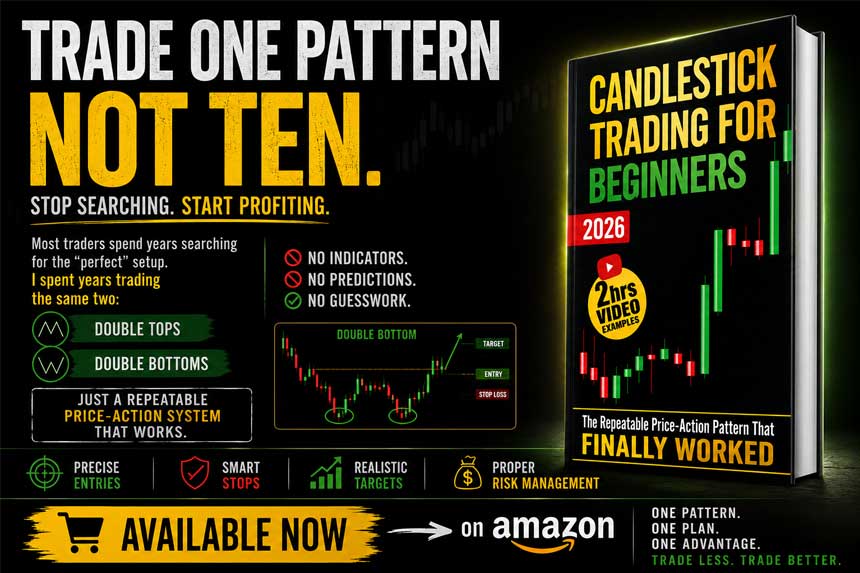
Check it out on Amazon.com
Check it out on Amazon.com