
Found this helpful? Save it for later or share it with another trader.
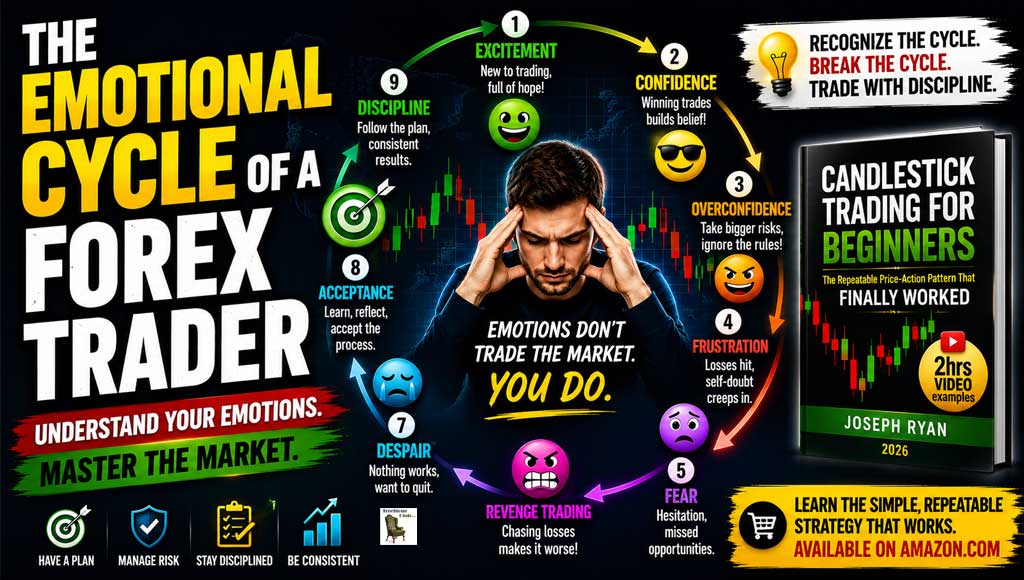
If you’ve traded Forex for more than a week, you’ve probably experienced it.
The excitement of finding a “perfect” setup.
The confidence after a winning trade.
The frustration when the next trade loses.
The temptation to change your strategy.
The determination to win it all back.
It’s a cycle almost every trader goes through.
The good news?
Recognising the emotional cycle is the first step towards breaking it.
Let’s look at each stage and, more importantly, how to stop your emotions from taking control of your trading.
Stage 1: Excitement
Everything is new.
Charts look fascinating.
You watch YouTube videos, read books, and dream about financial freedom.
You believe success is just around the corner.
Excitement isn’t a bad thing—it gets you started.
But excitement can also make you rush into live trading before you’re ready.
Better Approach
Stay curious, but take time to build a solid foundation before risking real money.
Stage 2: Confidence
You place a few trades.
Some of them win.
You begin thinking you’ve figured the market out.
This is often the most dangerous stage because confidence can quickly become overconfidence.
Better Approach
Remember that a handful of winning trades doesn’t prove a strategy works.
Consistency is measured over months—not days.
Stage 3: Overconfidence
This is where many accounts begin to unravel.
You increase position size.
You stop following your rules.
You believe you can “read the market.”
Soon you’re trading setups you would normally ignore.
Better Approach
Treat every trade exactly the same.
Winning shouldn’t change your rules.
Stage 4: Frustration
The market eventually reminds everyone who’s in charge.
A losing trade appears.
Then another.
Maybe three in a row.
Now doubt creeps in.
“Maybe this strategy doesn’t work.”
Better Approach
Losses are part of trading.
Judge your process—not individual trades.
Stage 5: Fear
After a few losses, every setup suddenly looks risky.
You hesitate.
You miss good opportunities.
Ironically, the trade you skip often becomes the biggest winner of the week.
Better Approach
If your strategy has an edge, trust the process.
One trade means very little.
A hundred trades tell the real story.
Stage 6: Revenge Trading
This is where emotions become expensive.
You want your money back.
Immediately.
You increase your risk.
You ignore your rules.
You force trades that aren’t really there.
Instead of recovering your losses, you usually make them worse.
Better Approach
Walk away.
The market will still be there tomorrow.
Stage 7: Despair
Every trader reaches this point at least once.
Nothing seems to work.
You begin questioning yourself.
Maybe you’re not cut out for trading.
Many traders quit here.
Ironically, this is often the point where the biggest lessons are learned.
Better Approach
Review your journal.
Look for mistakes.
Separate strategy problems from discipline problems.
Stage 8: Acceptance
Eventually you realise something important.
The market isn’t your enemy.
It isn’t trying to beat you.
It’s simply doing what markets do.
Your job isn’t to predict every move.
Your job is to manage risk and execute your plan.
This is where trading starts to become calmer.
Breaking the Emotional Cycle
You can’t remove emotions completely.
You’re human.
But you can stop them from making your decisions.
Here are the habits that helped me most.
Have a Written Trading Plan
Know exactly:
- What pattern you trade
- When you enter
- Where your stop-loss goes
- Where your take-profit goes
- How much you risk
- When you don’t trade
A written plan leaves less room for emotional decisions.
Risk Small
I risk only 1% of my account on each trade.
That means one loss is never a disaster.
Small risk keeps emotions under control.
Trade One Strategy
Many beginners jump between strategies every week.
I found the opposite worked better.
Learn one approach.
Understand it deeply.
Execute it consistently.
Avoid High-Impact News
News events create unpredictable price movements.
If your strategy relies on clean market structure, there’s no need to gamble through major announcements.
Keep a Trading Journal
Record:
- Why you entered
- Why you exited
- Whether you followed your rules
- How you felt
Over time, patterns in your behaviour become obvious.
Often the biggest improvements come from fixing yourself—not your strategy.
How I Reduced the Emotional Rollercoaster
One of the biggest improvements in my own trading came when I stopped trying to predict every market move.
Instead, I built a simple routine around one repeatable setup.
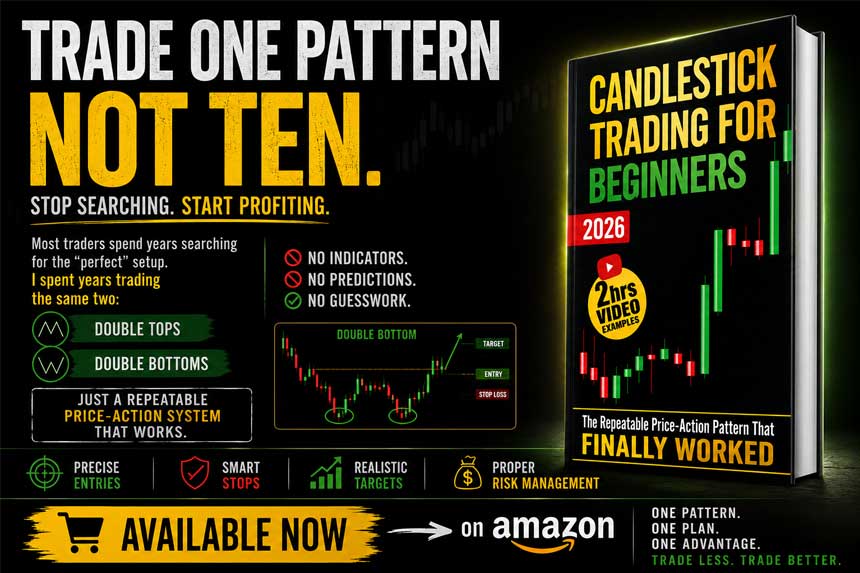
I trade Double Tops and Double Bottoms using:
- Pending orders
- Fixed stop-losses
- Fixed take-profits
- 1% risk per trade
- No trading into major news
- No overnight positions
Because many of the decisions are made before the trade begins, there’s much less room for emotion to interfere.
Trading became calmer.
Not perfect.
Just calmer.
Want to Learn the Complete Method?
Understanding trading psychology is important.
Having a process that helps reduce emotional decision-making is even better.
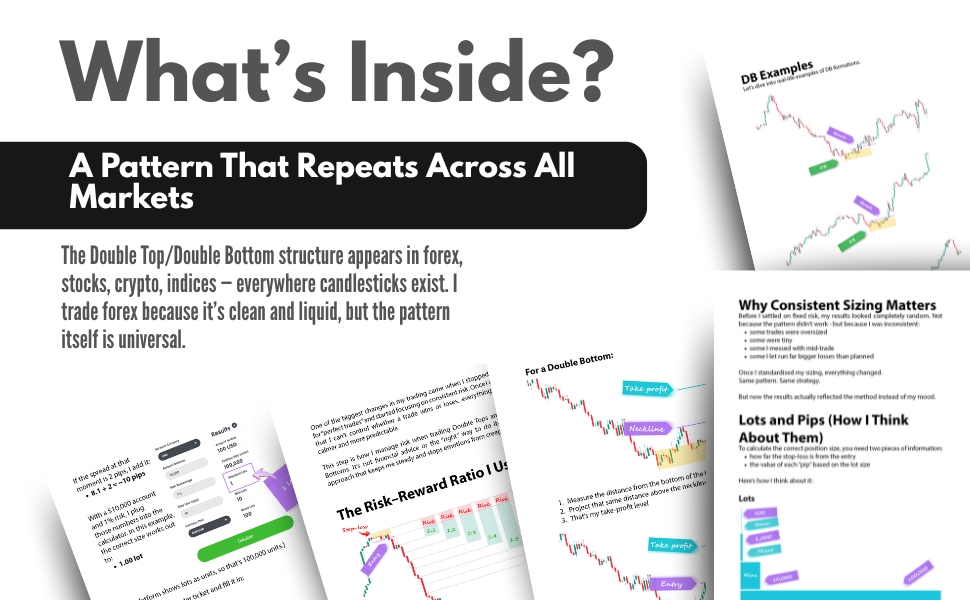
In Candlestick Trading for Beginners, I explain the complete rule-based approach I use to trade Double Tops and Double Bottoms, including:
✔ Pattern recognition
✔ Entry rules
✔ Stop-loss placement
✔ Position sizing
✔ Risk management
✔ Daily routines that keep emotions under control
If you’re looking for a straightforward trading method that removes as much guesswork as possible, it’s the natural next step after this guide.
Check it out on Amazon.com
Check it out on Amazon.com
Final Thoughts
The biggest battle in Forex trading isn’t with the market.
It’s with yourself.
Every trader experiences excitement, fear, frustration, and doubt.
The difference is that successful traders don’t let those emotions make their decisions.
Build a simple plan.
Manage your risk.
Stay patient.
And remember that consistency comes from repeating good habits—not chasing perfect trades.