
If you’re new to Forex trading, you’ve probably discovered one thing already…
Everyone seems to have a different opinion.
One person tells you to use ten indicators.
Another says indicators don’t work.
One trader says to scalp the 1-minute chart.
Another says only trade the daily chart.
It’s enough to make anyone’s head spin.
The good news?
Forex trading doesn’t have to be complicated.
In this guide, I’ll explain the basics in plain English and show you a simple path that every beginner can follow.
What Is Forex Trading?
Forex (Foreign Exchange) is the buying and selling of currencies.
Instead of trading company shares, you’re trading one currency against another.
For example:
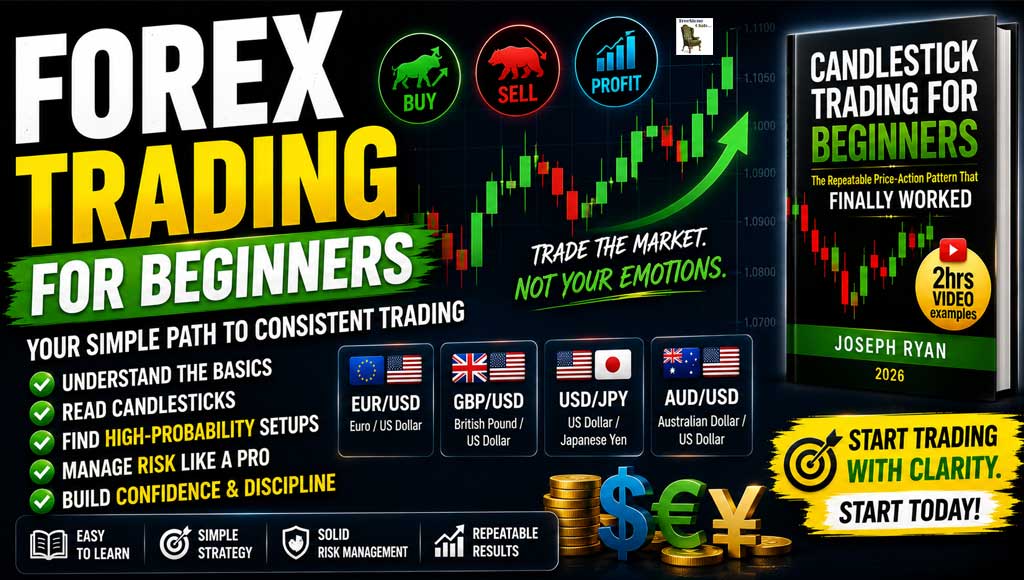
- EUR/USD
- GBP/USD
- USD/JPY
- AUD/USD
If you think one currency will become stronger than another, you buy.
If you think it will become weaker, you sell.
Every trade is simply a decision about whether one currency will rise or fall relative to another.
Why So Many People Trade Forex
Forex has become one of the world’s most popular financial markets because it offers:
- Markets open 24 hours a day during the trading week
- The ability to trade rising and falling markets
- Excellent liquidity on major currency pairs
- Plenty of trading opportunities each day
But popularity doesn’t mean easy.
Like any skill, trading takes time to learn.
What You Need Before You Start
You don’t need expensive software or multiple computer screens.
Most beginners can start with:
- A reliable Forex broker
- A trading platform
- A demo account
- A willingness to learn
- A simple strategy
That’s enough.
Learn to Read Candlestick Charts
Every Forex trader should understand candlestick charts.
Each candlestick tells you four things:
- Opening price
- Closing price
- Highest price
- Lowest price
Once you understand candlesticks, you’ll begin to recognise the patterns that buyers and sellers create over and over again.
They become the language of the market.
Keep Your Charts Simple
One of the biggest mistakes beginners make is filling their charts with indicators.
RSI.
MACD.
Moving averages.
Stochastics.
Bollinger Bands.
Soon the chart becomes impossible to read.
I found that everything became much simpler when I focused on price itself instead of trying to combine multiple indicators.
Clean charts make cleaner decisions.
Learn One Strategy
Beginners often jump between strategies every few days.
That usually leads to confusion.
Instead, choose one approach and learn it thoroughly.
For me, that approach is based on two simple chart patterns:
- Double Tops
- Double Bottoms
Rather than trying to predict every market move, I wait patiently for these patterns to develop, then follow the same rules every time.
Knowing one strategy well is far more valuable than knowing ten strategies poorly.
Risk Management Comes First
Most new traders focus on making money.
Successful traders focus on protecting their money.
Some simple rules I follow include:
- Never risk more than 1% of my account on a single trade.
- Always use a stop-loss.
- Know my exit before entering.
- Never chase price.
- Avoid major economic news.
- Accept that losses are part of trading.
Protect your account first.
Profits come later.
Practise on a Demo Account
A demo account lets you trade with virtual money.
It’s the perfect place to:
- Learn the trading platform.
- Practise placing orders.
- Understand risk management.
- Build confidence.
- Test your strategy.
Treat it as seriously as a live account.
Good habits developed early usually stay with you.
Keep a Trading Journal
After every trade, write down:
- Why you entered
- Why you exited
- Whether you followed your rules
- How you felt
- What you learned
Most improvements come from reviewing your own behaviour—not finding a new indicator.
The Biggest Beginner Mistakes
Almost every new trader makes at least a few of these:
- Risking too much
- Trading without a plan
- Chasing price
- Moving stop-losses
- Overtrading
- Trading during major news
- Jumping between strategies
- Letting emotions control decisions
The goal isn’t to avoid every mistake.
It’s to recognise them quickly and stop repeating them.
My Personal Approach
Over the years I realised I was making trading far more complicated than it needed to be.
Eventually I simplified everything.
Today my routine centres around:
✔ Double Tops
✔ Double Bottoms
✔ Pending orders
✔ Fixed stop-losses
✔ Fixed take-profits
✔ 1% risk per trade
✔ No overnight positions
✔ No trading during major news
The fewer decisions I make while a trade is active, the calmer and more consistent my trading becomes.
Simple doesn’t mean easy—but it does make discipline much easier.
Ready to Take the Next Step?
This guide introduces the fundamentals.
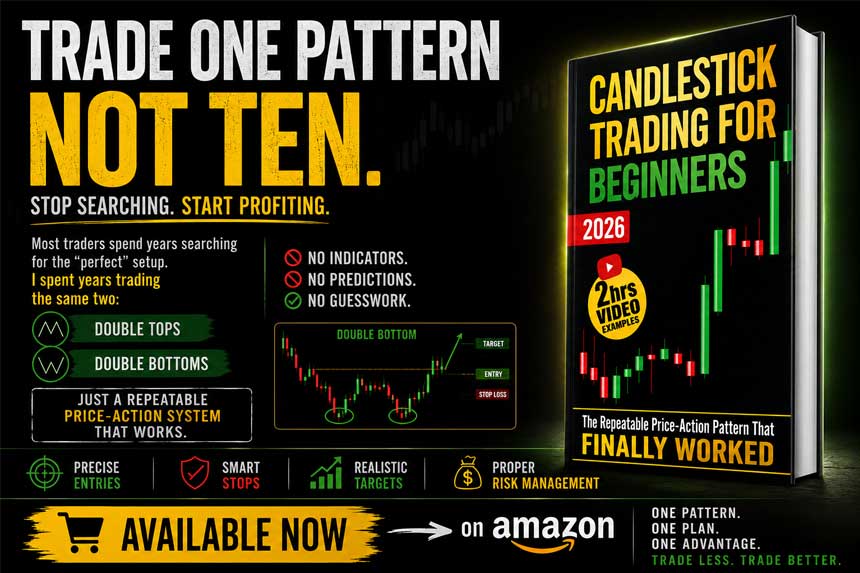
If you’d like to see how those fundamentals fit together into a complete trading method, my book, Candlestick Trading for Beginners, walks through the exact price-action strategy I use.
Inside you’ll discover:
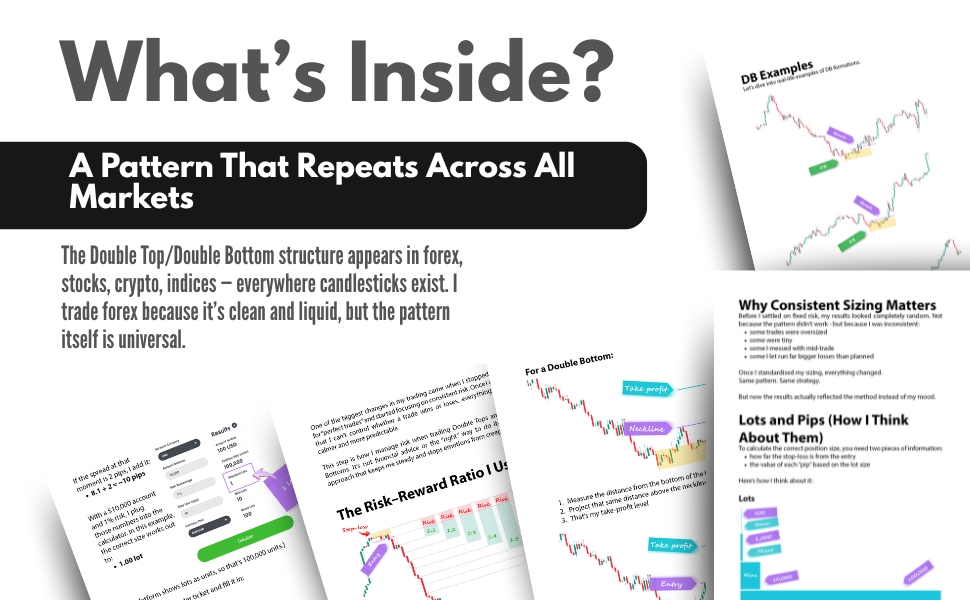
✔ How I identify Double Top and Double Bottom patterns
✔ The box method I use to qualify setups
✔ Entry rules using pending orders
✔ Stop-loss and take-profit placement
✔ Position sizing
✔ Daily routines that help remove emotion from trading
It’s written specifically for beginners who want a straightforward, repeatable approach without cluttering their charts with dozens of indicators.
Check it out on Amazon.com
Check it out on Amazon.com
Final Thoughts
Every successful trader started exactly where you are now.
Confused.
Curious.
Wondering where to begin.
The key isn’t learning everything.
It’s learning the right things in the right order.
Start with the basics.
Keep your charts simple.
Protect your capital.
Master one strategy.
Then repeat it consistently.
Trading isn’t about finding the perfect setup.
It’s about becoming the kind of trader who can execute a good setup, over and over again.