
Day trading forex doesn’t have to mean staring at charts all day, chasing every move, or juggling ten indicators at once.
My approach is the opposite of that.
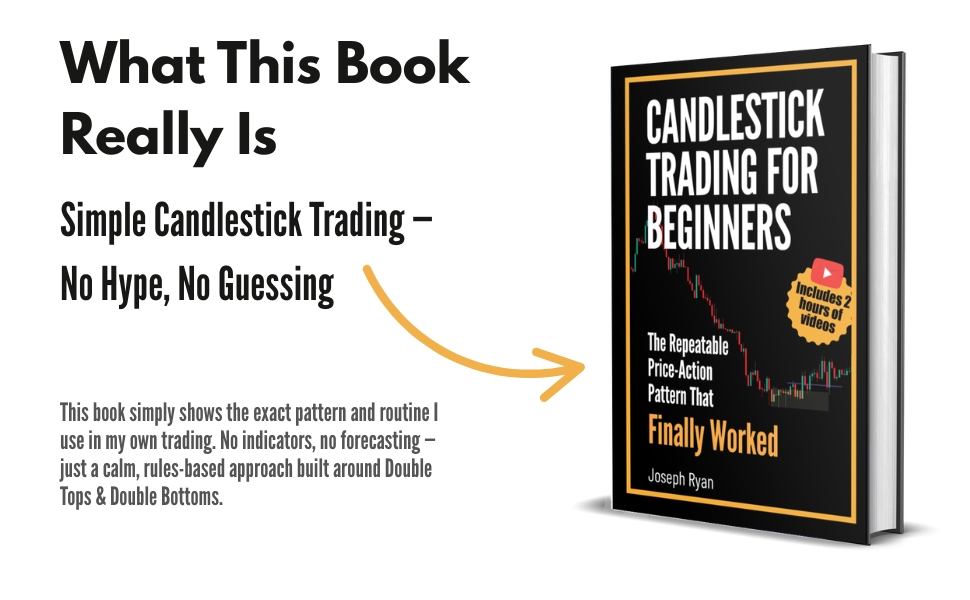
I use a simple, mechanical price-action strategy built around one pattern: Double Tops and Double Bottoms on the 1-hour and 15-minute charts. No indicators, no prediction, no gut feeling. Just structure, rules, and repeatable steps.
This post walks you through how I day trade forex, why I close everything by the end of the day, and the routine that helps me keep things as calm and consistent as possible.
What Day Trading Forex Means in My Approach
Day trading is simply:
- opening trades during the day
- closing everything before the trading session ends
- never holding positions overnight
I use intraday price movement on liquid forex pairs, but I’m not trying to catch every wiggle. I’m only interested in one type of structure forming on the chart – the Double Top (DT) and Double Bottom (DB) – and I let everything else pass.
A few advantages to this style:
- No overnight risk – I’m flat by London close, so I don’t wake up to surprise gaps.
- Clean structure – I trade mainly on the 1-hour and 15-minute charts where the DT/DB pattern is easy to see.
- Simple routine – I can plan trades, place pending orders, and walk away. No need to babysit the charts.
The Core Strategy I Use
1. The Only Pattern I Trade: Double Tops & Double Bottoms
I built my trading around one pattern:
- Double Top (DT) – a potential reversal after price has moved up
- Double Bottom (DB) – a potential reversal after price has moved down
In my method, I don’t just eyeball “two peaks” or “two troughs.” I follow a specific structure:
For a Double Top:
- Price makes a clear upward move.
- I mark a box around the last strong green candle at the top of that move.
- Price drops out of the box – showing the push up is weakening.
- Price then re-enters the box – this is where the DT often forms.
- I mark the neckline at the lowest point between the two tops.
- Price must move at least halfway back into the box – if not, I skip it.
Only then do I consider it a valid setup.
For a Double Bottom:
- Price makes a clear downward move.
- I box the last strong red candle at the bottom.
- Price climbs out of the box.
- Price returns back into the box.
- I mark the neckline at the highest point between the two lows.
- Again, price must come at least halfway into the box.
If any of those rules break (for example, a new higher high in the DT box), I delete the pattern and move on.
Check it out on Amazon.com
Check it out on Amazon.com
2. My Timeframes: 1-Hour and 15-Minute Candles
I mainly use:
- 1-hour charts – for clean, easy-to-see structure
- 15-minute charts – for more frequent patterns with the same rules
The pattern behaves the same way on both timeframes; the only real difference is speed. The 1-hour is calmer and clearer, the 15-minute gives more setups.
I’m not trying to trade every timeframe or every market. I’d rather know one pattern on two timeframes extremely well.
3. How I Enter Trades: Pending Orders Only
Once a valid pattern forms, I never jump in manually while the market is moving.
Instead, I use:
- Sell-stop orders below the neckline for Double Tops
- Buy-stop orders above the neckline for Double Bottoms
That means:
- If the neckline never breaks – the trade never triggers.
- If the pattern invalidates before the break – I delete the order.
- If price breaks cleanly – the order triggers automatically.
No chasing price, no split-second decisions. The order is planned calmly in advance.
4. How I Place Stop-Loss and Take-Profit
My exits are as mechanical as my entries.
For a Double Top:
- Stop-loss – above the top of the box.
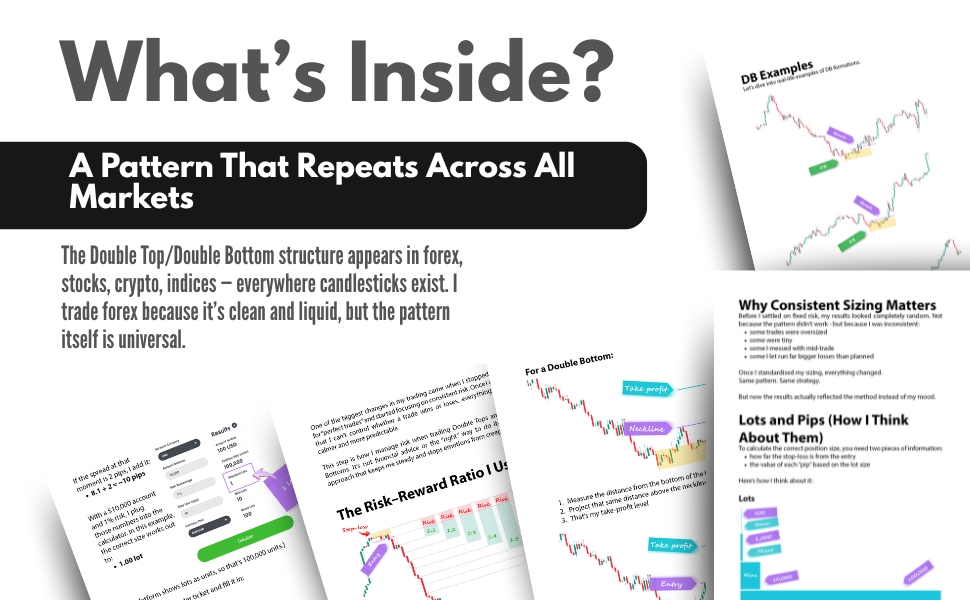
- Take-profit – distance from box-top to neckline, projected below the neckline (1:1).
For a Double Bottom:
- Stop-loss – below the bottom of the box.
- Take-profit – distance from box-bottom to neckline, projected above the neckline (1:1).
I use a fixed 1:1 risk–reward on every trade. It’s not about trying to squeeze huge winners; it’s about keeping the system simple enough that I can actually follow it.
5. How I Handle Risk: 1% Per Trade
I cap my risk at 1% of account balance per trade.
Example:
- Account: $10,000
- 1% risk: $100
- If my stop-loss is 20 pips away, I size the position so that 20 pips = $100.
I use a position-size calculator to do the maths. That way:
- one losing trade is never a disaster
- the system can play out over many trades
- my emotions don’t dictate position size
Consistency in risk matters more than finding “perfect” trades.
6. Why I Avoid Trading Into Major News
Even with a clean pattern, high-impact economic news can wreck an otherwise good setup.
So I:
- check the economic calendar before trading
- avoid placing orders near major releases
- close any active trades before big scheduled news
- wait until the market settles before looking for new setups
This keeps slippage, spread spikes, and wild spikes out of the equation and protects the integrity of the strategy.
7. No Overnight Trades
All trades are:
- opened during the day
- managed by pending orders, stop-loss, and take-profit
- closed by the end of the session (London close)
If neither stop nor target is hit by then, I close the trade manually and reset.
No exceptions.
This keeps:
- risk contained
- results easier to track
- my mind off open positions when I’m away from the screen
Practical Habits That Make This Work
The method is simple. The hard part is sticking to it. Here are a few habits that help.
1. A Written Trading Plan
I keep the rules in writing:
- how I define a valid DT/DB
- when I place orders
- how I place stops and targets
- when I avoid trading (news, late sessions)
- when I stop for the day
That written plan stops me from “winging it.”
2. Discipline Over Emotion
There will always be:
- tempting near-setups
- days with no trades
- runs of losses
Discipline means:
- not entering before the neckline break
- not moving stops “just a little bit”
- not forcing trades late in the day
- not doubling risk after a loss
The strategy works as a whole, not trade-by-trade. My job is to execute, not to outsmart it.
3. Keeping a Simple Trading Journal
After each trade, I record:
- pair, timeframe, pattern (DT/DB)
- screenshot or note of the boxed candle and neckline
- entry, stop, target
- whether I followed the rules
- result (win/loss, 1:1)
- any mistakes or emotional reactions
Over time, patterns in my behaviour show up, and that’s where the biggest improvements usually come from.
Tools and Resources I Use
You don’t need a huge toolkit for this method. Just:
- a reliable broker with tight spreads on major pairs
- clean 1-hour and 15-minute charts
- a position-size calculator (I use a simple online one)
- an economic calendar
- a notebook or digital journal for recording trades
That’s enough to run this approach properly.