
If I could give every new Forex trader just one piece of advice, it would be this:
Never risk too much on a single trade.
It sounds almost too simple.
After all, most beginners spend their time looking for the perfect entry, the perfect indicator, or the perfect strategy.
But experienced traders know something different.
Protecting your account is far more important than finding the next winning trade.
That’s where the 1% Risk Rule comes in.
What Is the 1% Risk Rule?
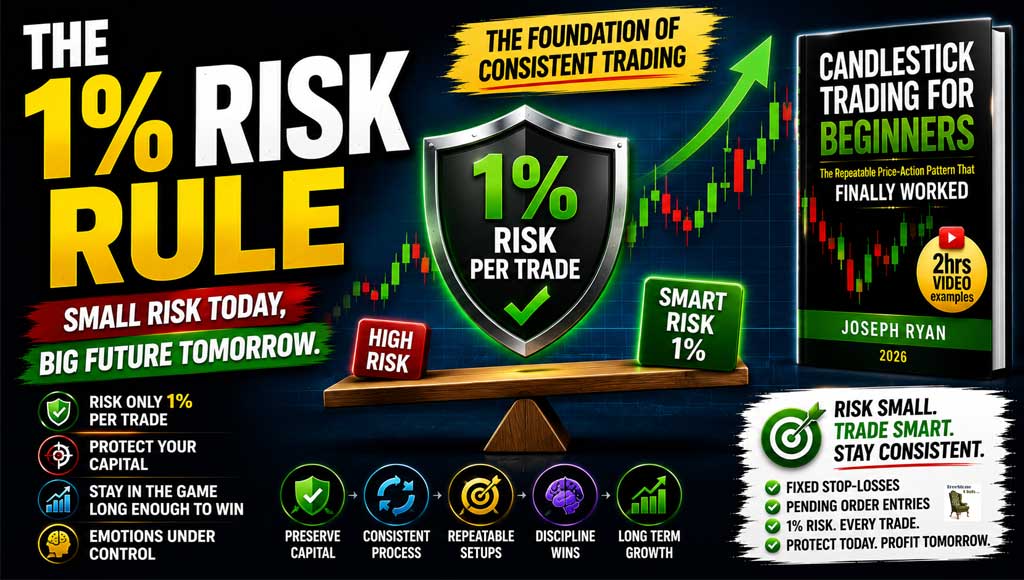
The 1% Risk Rule means you never risk more than 1% of your trading account on a single trade.
For example:
Account Balance: $10,000
Maximum Risk:
1% = $100
That means if your stop-loss is hit, the most you lose is $100.
Not $500.
Not $1,000.
Just 1%.
Every trade starts with one simple question:
“If this trade loses, am I comfortable losing 1%?”
If the answer is no, the position is too large.
Why the 1% Rule Works
Trading is a game of probabilities.
Even excellent strategies have losing trades.
Sometimes you’ll lose:
- Two in a row
- Three in a row
- Five in a row
That’s completely normal.
The 1% Rule allows those losing streaks to happen without destroying your confidence—or your account.
Small losses are easy to recover from.
Large losses are not.
The Maths Behind It
Imagine two traders.
Trader A
Risks 10% on every trade.
Five losing trades in a row.
Account balance:
$10,000 → about $5,900
Nearly half the account has disappeared.
Now the emotional pressure is enormous.
Trader B
Risks 1% per trade.
Five losing trades in a row.
Account balance:
$10,000 → about $9,510
The account is barely damaged.
More importantly, Trader B can continue following the plan without panic.
That’s the real power of the 1% Rule.
How I Use the 1% Rule
Every trade begins exactly the same way.
First, I identify a valid setup.
For me, that’s a properly formed:
- Double Top
- Double Bottom
Once the pattern is complete, I know exactly where my stop-loss belongs.
Only then do I calculate my position size.
I don’t change the stop to fit the position.
I change the position to fit the stop.
That one habit keeps every trade consistent.
Position Size Comes Last
Many beginners decide how many lots they want to trade before they know where the stop-loss belongs.
That’s backwards.
The correct order is:
- Find a valid setup.
- Place the stop-loss where the chart says it belongs.
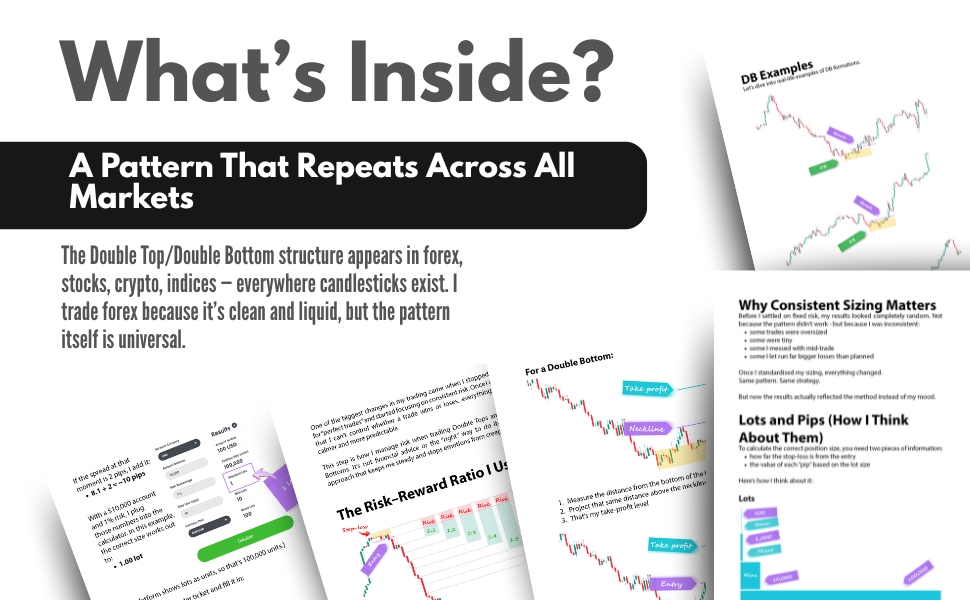
- Decide how much money you’re willing to risk (1%).
- Calculate the correct position size.
The market decides the stop-loss.
You decide the risk.
Why Bigger Risk Doesn’t Mean Bigger Success
It can be tempting to think:
“If I double my position size, I’ll make money twice as fast.”
The problem is you’ll also lose money twice as fast.
Large positions create:
- Fear
- Hesitation
- Poor decisions
- Revenge trading
Small, controlled positions keep emotions under control.
That’s exactly what we want.
The 1% Rule and Trading Psychology
One of the biggest benefits of risking only 1% is psychological.
When the outcome of one trade isn’t financially devastating, it’s much easier to:
- Follow your trading plan.
- Accept losses.
- Avoid moving stop-losses.
- Stay patient.
- Wait for quality setups.
Good trading decisions become much easier when fear isn’t driving them.
The 1% Rule Fits a Mechanical Strategy
My own trading approach is designed to remove as much emotion as possible.
I trade:
✔ Double Tops
✔ Double Bottoms
✔ Pending orders
✔ Fixed stop-losses
✔ Fixed take-profits
✔ No trading during major news
✔ No overnight positions
Adding the 1% Rule means every trade follows the same structure.
Nothing changes because I “feel confident.”
Nothing changes because I “need to win.”
Every trade is treated exactly the same.
That’s what creates consistency.
Common Mistakes to Avoid
Increasing Risk After a Win
Confidence should never change your position size.
Doubling Risk After a Loss
Trying to “win it back” usually makes things worse.
Moving Your Stop-Loss
The stop belongs where the chart says it belongs—not where your emotions want it.
Guessing Position Size
Always calculate it.
Never estimate.
Want to See How It All Fits Together?
Risk management is only one part of successful trading.
The real benefit comes when it’s combined with a clear, repeatable trading strategy.
In Candlestick Trading for Beginners, I show exactly how I combine:
✔ Double Top and Double Bottom patterns
✔ Pending order entries
✔ Fixed stop-loss placement
✔ 1:1 take-profit targets
✔ Position sizing using the 1% Rule
✔ Daily routines that help remove emotion from trading
The result isn’t a system that wins every trade.
It’s a process that’s designed to stay consistent over hundreds of trades.
Check it out on Amazon.com
Check it out on Amazon.com
Final Thoughts
The 1% Risk Rule isn’t exciting.
It won’t make headlines.
It won’t turn a small account into a fortune overnight.
What it will do is help keep you in the game long enough to improve.
Every successful trader has losing trades.
The difference is that successful traders never let one loss become a disaster.
Protect your capital.
Follow your plan.
Think in probabilities.
Because in trading, survival always comes before success.